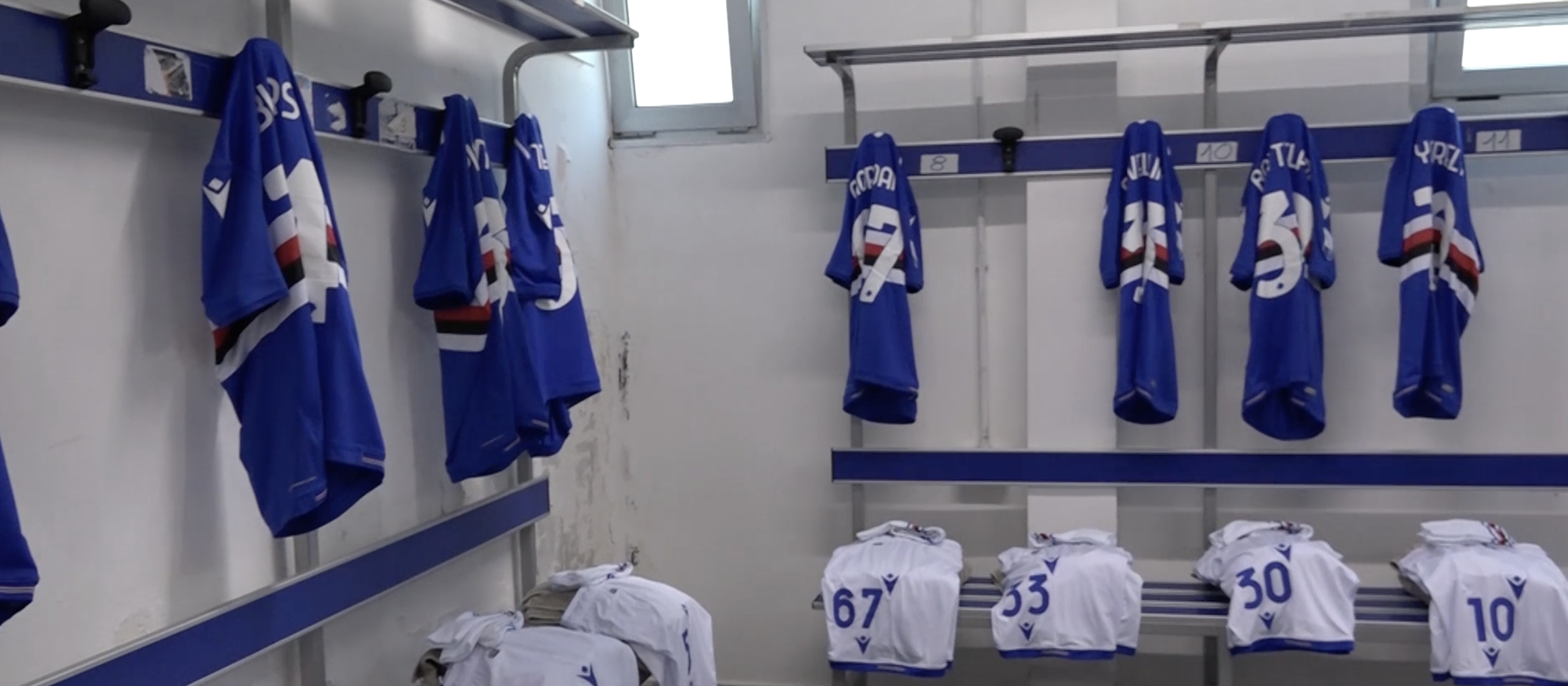
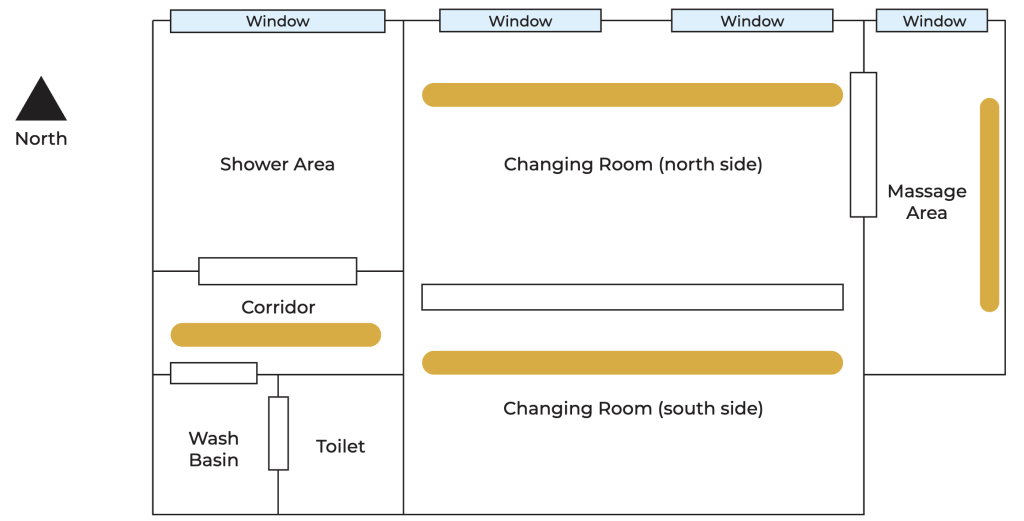
The changing rooms of the junior Sampdoria FA team are in Bogliasco (Genova, Italy), close to one of the three football pitches of the Sampdoria training site. The locker rooms are located in a reinforced concrete small building, with north-facing windows that are new, but not perfectly sealed. On the north side of the changing rooms, there are three football pitches. Because spring winds are mainly from the north and northeast, as well as the non-perfect sealing of the windows, this results in a continuous provision of environmental microbes and yeast from the northern fields. Therefore, in these rooms, Biovitae lights were installed and tested.
The background
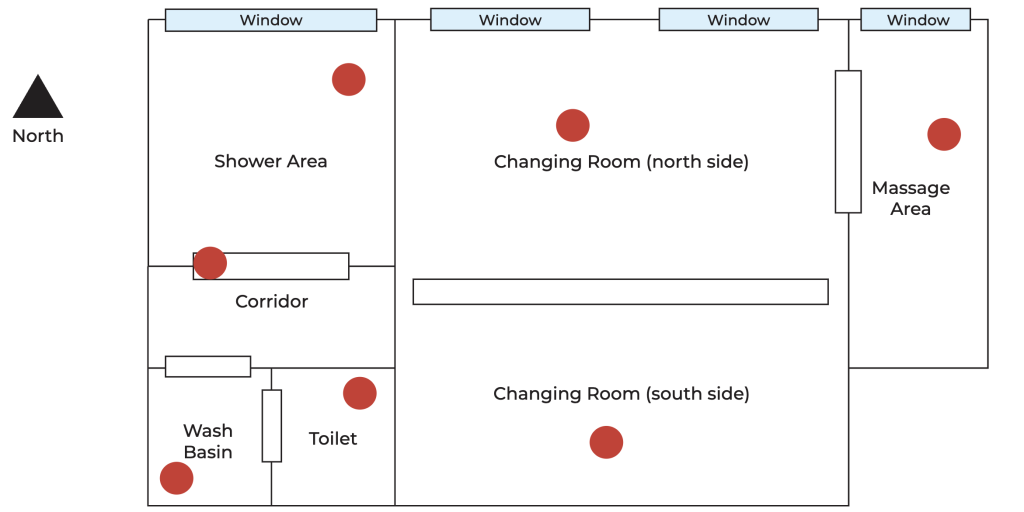
The changing rooms were divided into different zones and sampling zones were identified together with the medical staff of the football team zones. Then, samplings were performed in 24 hours, starting from Monday 9.00 am to Tuesday 9.00 am, then from Tuesday 9.00 am to Wednesday 9.00 am. Thus, the reference period (lights off) consisted of 24 hours where telluric bacterial flora and yeasts were measured.
The test period (lights on) consisted of a 24-hour period where inhibition of the proliferation of the telluric flora by Biovitae lights was controlled in the same experimental conditions. To enumerate the colonies on agar plates (namely, blood agar for gram-positive and gram-negative bacteria and Sabureau agar for yeasts from Biomerieux), agar Petri dishes were opened and left to lay on the ceiling.
After 24 hours, plates were collected, sealed and incubated at 37°C for 24-48 hours. Next, the number of colonies was counted by two different technicians and experts in the field. For yeasts, the colonies were counted after another 48 hours at room temperature. The counts were performed visually. During the whole period of the test, locker rooms were closed and no one was admitted inside. Thus, tests were performed in very basal conditions, avoiding the effects of the presence of athletes. In addition, because locker rooms were closed to athletes for the test, the whole experiment was performed only once in the very short period when workouts were suspended due to the COVID-19 epidemic.
The results
Bacteria colony count
Area
Massage
Day 1
17
Day 2
3
% of inhibition
82.4%
Biovitae Lights
On
Area
Locker (north)
Day 1
32
Day 2
6
% of inhibition
81.3%
Biovitae Lights
On
Area
Showers
Day 1
216
Day 2
168
% of inhibition
22.2%
Biovitae Lights
Off
Area
Wash Basin
Day 1
23
Day 2
3
% of inhibition
87.0%
Biovitae Lights
Indirect
Area
Toilet
Day 1
28
Day 2
6
% of inhibition
78.6%
Biovitae Lights
Indirect
Area
Corridor
Day 1
37
Day 2
7
% of inhibition
76.7%
Biovitae Lights
On
Yeast Colony Count
Area
Massage
Day 1
20
Day 2
3
% of inhibition
85%
Biovitae Lights
On
Area
Locker (north)
Day 1
31
Day 2
3
% of inhibition
90.3%
Biovitae Lights
On
Area
Showers
Day 1
150
Day 2
4
% of inhibition
97.5%
Biovitae Lights
Off
Area
Wash Basin
Day 1
32
Day 2
3
% of inhibition
90.6%
Biovitae Lights
Indirect
Area
Toilet
Day 1
29
Day 2
6
% of inhibition
79.3%
Biovitae Lights
Indirect
Area
Corridor
Day 1
24
Day 2
7
% of inhibition
70.9%
Biovitae Lights
On
The findings
Data collected in the small but interesting test performed on Biovitae lights positioned in the changing rooms of a football team indicates that both bacteria and yeast are inhibited. This result is in line with what has already been observed in a more controlled “laboratory” setting by using standard strains of microbes. Added values of this experimental setting can be identified. Indeed, the results observed were obtained in real-life conditions, with real changing rooms, real windows, real microbes and yeast.
In addition, Biovitae lights were installed as “normal” lights under the ceilings. Unfortunately, in the shower area, due to technical reasons, lights were switched off and a worse inhibition was observed. In the same context, other points should be considered. First, inhibition of the proliferation of bacteria and yeast was not strictly related to the presence of “direct” irradiation on the surface, but also by diffusion and reflection of the light. This was evident in positions (such as the toilet, where the light was diffused and/or reflected by the corridor lamp). But even more interestingly, despite the shower light was off, the diffusion of the corridor light weakly inhibited bacteria (-20%) but strongly (and surprisingly) inhibited yeasts.
Nevertheless, statistics should be used in the context of a well-performed (and repeated) experimental setting. In the present conditions, an average 80% inhibition of the number of colonies is probably already suggestive of the activity of the lights. Despite the above-mentioned warnings, the whole experiment was indicative of the capacity of Biovitae light to inhibit bacterial and yeast proliferation in a real-life setting. Overall, this finding supports the use of the Biovitae lights in other environments where the control of microbiological contamination could be indicated.
This project was carried out by Biovitae. We are the only UK approved supplier of Biovitae Sanitising Lights.